Components and hardware catalogues define what makes up each platform type at a technical level.
Platform components
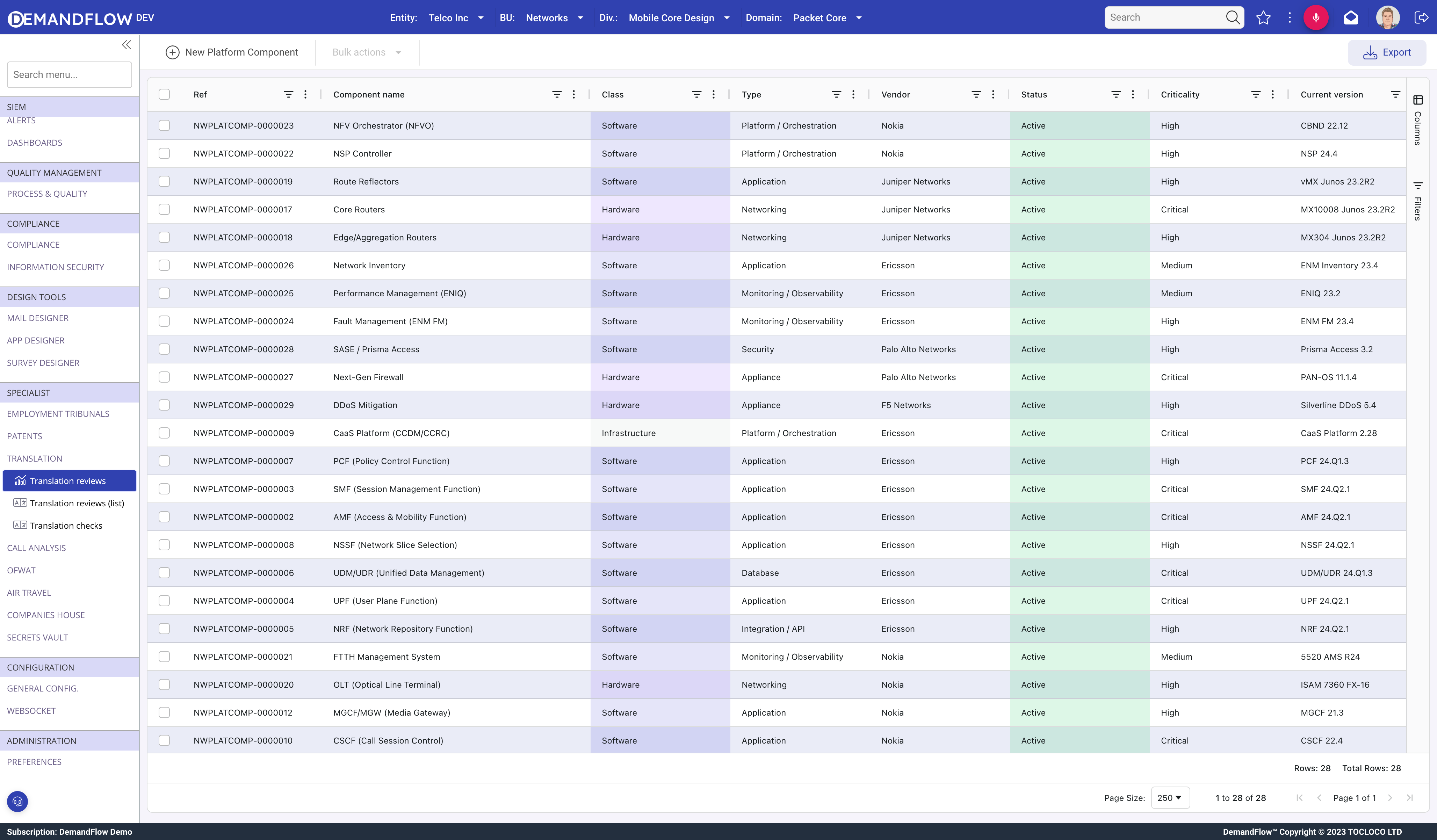
Components are the building blocks of a platform type. Each component record captures:
- Component Class: Software, Hardware, or Infrastructure (colour-coded).
- Component Type: Application, Middleware, Database, Platform/Orchestration, Integration/API, Security, Monitoring, Messaging, Compute/Server, Storage, Networking, Appliance, Power/Cooling.
- Vendor, Description, Status (Planned, Active, Deprecated, Retired).
- Criticality, Current Version, Licence Type (Commercial, Open Source, Internal/Proprietary, SaaS/Subscription).
Component dependencies
Components can depend on each other within a platform type. Each component dependency captures:
- Source Component (depends on) and Target Component (depended on).
- Dependency Type: Runtime, Data/Storage, API/Interface, Messaging/Event, Authentication/Authorisation, Configuration/Discovery.
- Criticality and Protocol (e.g. HTTP/2, Diameter, SBI, gRPC).
Hardware types
Hardware types are an abstract catalogue of hardware families used by network platforms. They define classes like "HPE ProLiant", "Juniper MX", "AWS EKS" rather than tracking physical inventory.
- Hardware Category: Server, Storage, Networking, Cloud/IaaS, Appliance, Virtualisation, Container Platform, Accelerator/GPU.
- Vendor and Description.
- Related list of Versions/Generations (e.g. Gen 10, Gen 11).
Hardware versions
Each hardware version tracks a specific generation with lifecycle dates:
- Version (e.g. "Gen 11", "v1.28"), Specs (CPU, memory, storage capabilities).
- Release Date, End of Sale, End of Support, End of Life (all flagged when past).
- Status: Planned, Current, Supported/not-current, End of Sale, End of Support, End of Life, Retired.
Hardware requirements
Hardware requirements link components to hardware versions, specifying compatibility:
- Requirement Type: Minimum, Recommended, Certified, or Maximum.
This enables compatibility checking: before upgrading a component, you can verify it is certified to run on your current hardware version.
Tips
- Define components at the platform type level, not per instance. All instances of a type share the same component architecture.
- Use hardware requirements to prevent upgrades to incompatible configurations.
- Hardware version lifecycle dates feed into the EOL Roadmap alongside software versions, giving you a unified view of currency across both layers.